Before the district is covered in a smoky haze, I want to give you my guide to fire use in farming 101…
There are three types of burning that happens throughout the year. There are tracer breaks, fire breaks and spring burning (burning off).
Fire is a natural phenomenon with numerous causes. Ranging from natural lightning strikes to arson. But it is also used as a management tool and this is where it needs explaining.
Tracer lines are done during March / April and the main aim of tracer breaks is to make your fire breaks less dangerous, give them less chance of spreading out of control and running away. They are very common in forestry areas or inaccessible terrain. They are described as “fuel free” strips. The farmer sprays chemicals on the area surrounding the fire break area. When the time has come to burn the fire break, the area has been burnt off and they have a barrier to work against.
Fire breaks have many uses. Their main aim is to stop a runaway fire that ravage areas in winter when the grass is dried out and flammable, they can also be used as a line to fight the fire from in terms of doing a back burn (while trying to get a big fire under control a control burn is lit to move towards the oncoming fire, burning all fuel in its path) and they help protect property from a fire that is out of control. Fire breaks are burnt during June and it is average for a farmer in our area (midlands) to burn an external break, around the boundary of the farm, and a few internal breaks, to “cut” the farm into manageable sizes to control any runaway fire. They are normally burnt on a fence / tree / road line, 15-20 m wide. The best way to burn a break is to burn into the wind against a water line, sprayed down by your water tanker. General behaviour of fire must be heeded constantly eg a fire runs up hill, it can creep through kikuyu or scrub under a plantation and it can jump on tree tops, it does not need to run along the ground.
The FDI (Fire Danger Index) is usually sms’ed out to members of the Fire Association twice daily during FB season. Blue means insignificant wind speeds and low fire danger, while red is extremely dangerous conditions expected and any fire is likely to become out of control.
The third type of burning is the spring burn or burning off. This happens after the first significant spring rains in August / September. During the year grass gets moribund ((of a thing) in terminal decline; lacking vitality or vigour.) Fire is again used as a management tool to clear this old grass and make way for new green young shoots. Fire is also used to clear any unwanted brush and weeds and to kill off the tick and parasitic worm challenge that has built up over the year. Fire brings a flush of new grass which improves the grazing and in turn then improves the animal condition grzing on the grass. Fire also restores the diversity of the grassland and restores it to natural health.
Fire is used as a management tool by the farmer and the area where the farm is situated depends on which burn and how often they burn. Especially in the midlands area, the development of centre pivots and the establishment of rye grass pastures , limits the needs for fire breaks every year but in terms of managing the veld, they will always be needed.”
There is the constant argument about fire breaks and the need to actively put in fire which always has the risk of running out of control vs just dealing with problems when and if they occur.
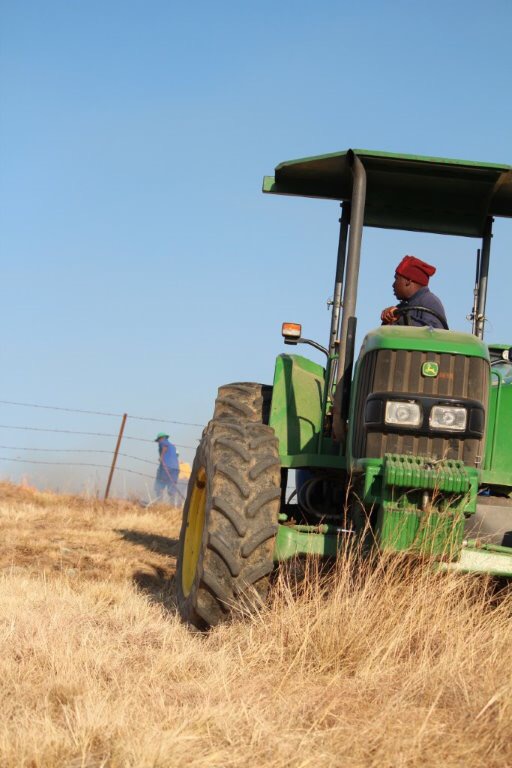
The farm crew burning – July 2015 ….. all hands on deck !


this article I based on my experiences only- it is not a rule for all farms.

 Pink Farm Chick