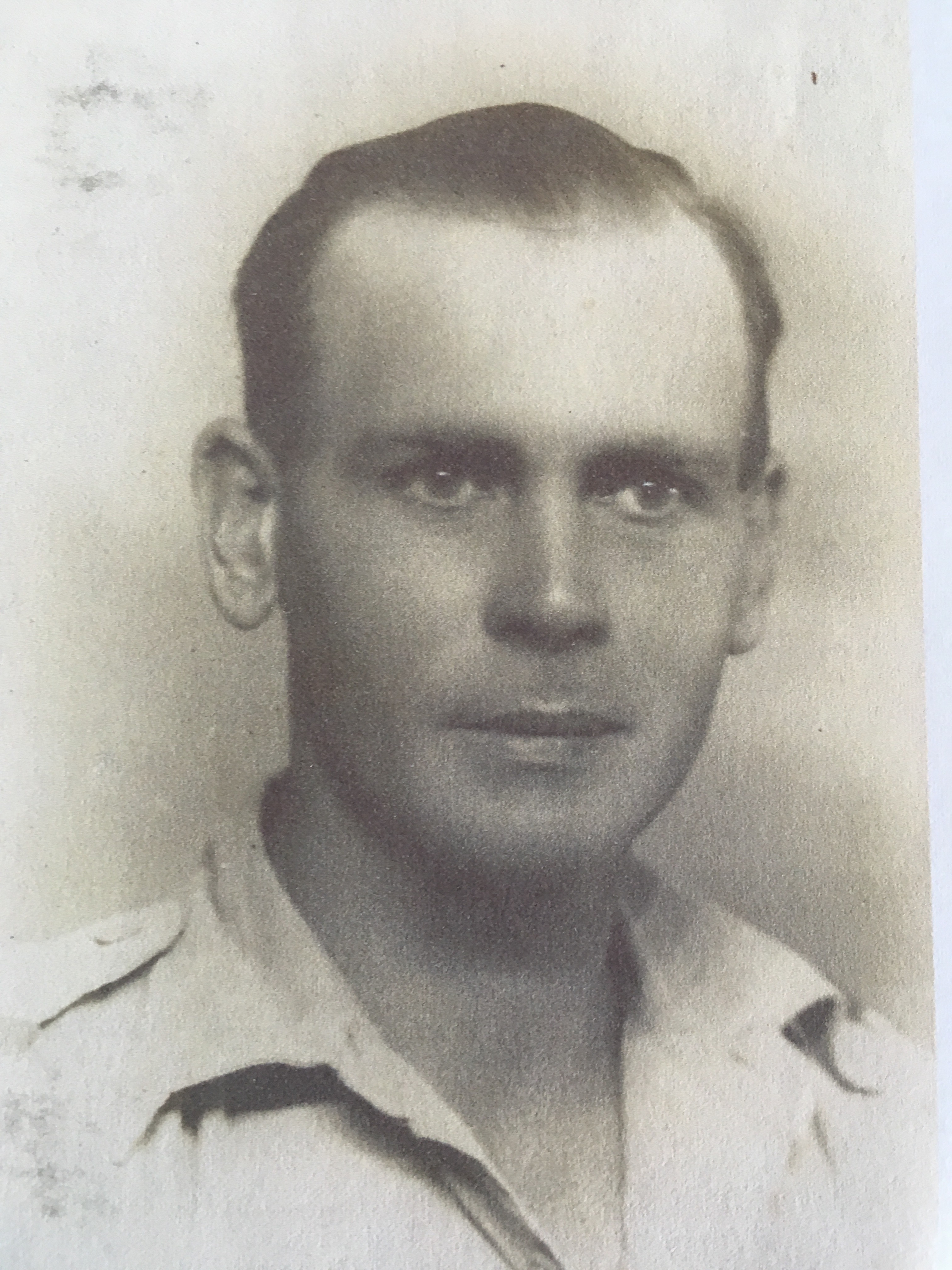


by JM Kirkman
When my mother (Grace Kirkman, nee Dickens) died in 1965, people said what a pity she had not written her memoirs, as she had had a very colourful and eventful life. Well, I decided that the same must not be said of me. Hence this treatise. I hope it will entertain, and perhaps, give you a few tips or a laugh or two. It is not a classic and may be too short for some! But never mind, I hope a good time will be had by all.
Our sugar estate was bought about 100 years ago by my grandfather, John Kirkman and his brother Thomas, my uncle. It was quite hilly and had a waterfall of some 200 – 300 feet. This, they made full use of. Apart from irrigation i.e. of cotton, sugar, fruit trees, etc. it was directed by a pipeline on a pelton wheel, which gave the small sugar mill power and electric light. In this furrow we, as youngsters, used to catch eels nine inches long.
The house was on a knoll, with verandas one three sides. Guttering round the building collected rain water which was lead into a large underground tank. The water was pumped up by a single action old hand pump. The lighting of the dwelling was by acetylene gas, generated at the back of the building. All the rooms were spacious, ideally suited to the hot Natal coast climate.
A vivid recollection of my early childhood took place on a Sunday afternoon. Mother was reclining on a sofa on the veranda reading. Dad was in the dinning room also reading. Mother heard panting. She looked up and there was an Nkonka (bushbuck male) looking at her, only two yards away. She called to Dad who replied, “I think, my dear, you are dreaming”. Whereupon she threw the book at the buck and yelled for the dogs. The poor, unfortunate animal skidded on the concrete floor of the veranda, but was away in a flash having cleared the railing of the veranda and hedge. The dogs were in hot pursuit. Fortunately the buck made his escape into the sugar cane.
A hibiscus hedge was adjacent to the office. Dad kept the switches for his horses in the hedge and next to this was a hitching rail. He would ride up from the sugar cane fields or the mill, dismount and shout “Webbo!” this was the signal for the stable boy to collect the horse and water and feed it and bring another.
Our family was great on planting trees. Apart from the common blue gums, wattle, etc they planted mangoes – eight different varieties – breadfruit (or jack fruit), custard apple, sweet lemon, Seville oranges and many others. They also established cedreala odorata (from Cuba). This is the “cigar box” wood. This wood takes oil exceptionally well and one can hammer a 4 inch nail into the end of a 1 inch plank without splitting it. The incense cedar which has a redheart wood and a white sap wood, was also established, makes excellent furniture. The Indian cane bamboo thrived and was used for making fishing rods.
One of my earliest memories in this happy valley was riding on the bumpers of full cane trucks going down to the mill. I would be carrying my fishing tackle and be accompanied by my dog Mac. The tackle composed of a bamboo stick, string, a bent pin and some worms. We fished the cooling tanks at the mill where the platanas (platties) thrived. This was a slimmer, messy business!
If we were lucky, the can trucks would be returning to be reloaded thus we obtained a lift home.
Our estate Beaverstowe, was approximately 17 miles from Park Rynie and Ifafa Beach where my father had a plot of ground. Needless to say we often packed up to spend a day or weekend at the beach. Prior to the advent of the motor car (Model T ford) my parents used to travel by carriage and pair to play tennis at Umzinto 7 miles away. Taapai, the zulu boy, used to hold the horses and see Mother and Dad off. By the time they reached the tennis courts Taapai was already there, waiting for them. What stamina as compared with modern youth!
On one occassion when my father was teaching Mother to drive the Ford, she became very annoyed and an altercation ensued. In the heat of the moment words were exchange and Mother said “ Drive the d___ thing yourself!” My father immediately obliged. When telling this story many years later my father quipped “Well my dear, I wanted to catch the tide”.
During the July holiday the local angling Club usually held a junior fishing competition when children of members could take part. First there would be the casting in different age groups followed by the fishing. Each age group was allowed to catch different types of fish. The youngest group could catch anything – tobies, bait steelers, etc. The time of “weigh in” was set, after which prizes were presented. Then the real fun started for us children – ice cream, cold drinks and other party fare. After this the drive home would always prove exciting with the eyes of bush buck, rabbits, cane rate and ant bears to mention a few, seen in the car’s headlights. I won quite a few prizes at these competitions and one I cherished most was a 3 inch centre pin bakelite reel, which I kept until I was 59 years old! Ath the same meeting I won 300 yards of 3 cord line.
I well remember my first contact with the sardines. This was at Fuwka Rocks near the Umzinto River mouth (Kelso). We arrived to find fish on the beach, in pools, birds diving, big fish jumping and only eight fishermen present, including one Indian. Compare this with the present day glass fibre forest! I can’t remember the exact number of fish caught, but most residents of Scottsburg, Umzinto and Umkomaas had as much fish as they could take away.
On one occasion, my brother Lionel and I were taken to Post St. Johns on a fishing trip. On the way down, just outside Lusikisiki, our model T Ford split its radiator. The proprietor of the local hotel, on hearing of our predicament, took my Dad down the road to get a radiator off a similar car which had broken its back axle. Fortunately this radiator was sent back to Lusikisiki on the S S Frontier, a coaster, which used to ply between East London, Port St Johns, Port Shepstone, Umkomaas and Durban. How the people of those days trusted one another! I clearly remember seeing the coaster come into the river mouth at Port St Johns and tie up at the wharf, which is now a National Monument.
One of the numerous stories of the early days which was passed on to me concerns the old steam car. The owner was travelling between Umzinto and Esperanza and, as usual in those days, overtook a group of native women carrying bundles on their heads. The women panicked, ran across the road and the driver knocked an “umfazi” over. On investigating, he saw a body, blood and entrails all over the road. He reported this to the sergeant of the Natal Police who returned with him to the scene of the accident. They found no one so they proceeded towards Esperanza and came across the same umfazi with her bundle. On being questioned, she admitted that she had been knocked over by a car. The sergeant then asked what she had in her bundle and she replied “matumboos” (sheep’s entrails).
I seem to have strayed somewhat from my favourite subject – fishing! As previously mentioned, we grew Indian cane on Beeverstowe primarily for making fishing rods. These bamboos had to be planted away from water to produce stronger rods. They had to be cut at a certain stage of the moon but I do not remember whether it had to be waxing or waning. After removing the branches, the rod was laid in a manure heap for 10 days. We would then heat the notches with a blow lamp, rub on raw linseed oil, and then nail the rod to a plank for at least three months. Finally we would bind each side of each knot and attach the eyes.
Having made my first light tackle rod, Mac and I used to go down with “gallicks” (the fully loaded can trucks). The sugar cane was cut by hand, loaded onto there trucks and gravitated down to the sugar mill. I used to help (or hinder) with the brakes of these vehicles. Some of the break boys were so expert, that they could take six loaded and coupled cane tracks together and seldom came off the tracks. These tracks were transported by “gollavans” which were the plate layers means of transport of rails, from on field to another, ahead of the cutting gangs. It was great fun riding this way until Lionel was caught between two bumpers but luckily escaped with only a grazed knee.
I used to go out with an airgun and we were allowed fifteen pellets a day, having to account for every pellet at the end of it. We shot only the birds which were destroying our fruit. There was a patch of Mauritius thorn (wag ‘n bietjie) close to a garden with pawpaw trees. It was really surprising to hear of the number of birds which had fallen into this impenetrable mass of thorns!
On very important occasions, organised shoots were arranged. The guns were given positions and woe betide the person who didn’t stay there. The buck that were shot were taken to the house and displayed. Then came the Zulu initiation ceremony, and by tradition, any “young blood”, European or black, who had shot and killed his first buck, was expected to eat the raw tripe of his buck, after it had been removed and cleaned. If he failed to do this, he was not an Nsizwe (man) but remained and umfaan for the rest of his life.
At one stage, it was the “in” thing to collect trophies of animal shot. With the advent of the Parks Board (1945) this, thank goodness, has died out.
We had a very good, loyal African who was an excellent shot and was issued with a 12 bore shotgun for the purpose of shooting monkeys. These were a curse as they nibbled the young can plants near the roots, thus causing them to die. He would be given twenty-five rounds of ammunition, and on producing tails of his victims, would receive half-a-crown. He would braid the skins and, by arrangement with Dad, sent them to Durban where they sold for up to £2.10 each. He camouflaged himself extremely well with the surrounding bush and could imitate monkeys and most of the birds very successfully.
When a field of cane had to be replanted, the old cane was burnt first. During this operation, all the Pondo cutters would collect round the field and watch for cane rats to appear. As soon as one was killed, they would cut off the tail, thus converting the rat into a pig, and according to their tradition, which was then edible.
The quail would arrive in September / October in their hundreds and great fun was had by all the sportsmen. We used to walk in a line, one gun, one beater, one gun and so on, with maybe a dog, pointer or retriever, across the “tops” where there were old African mealie fields.
As youngsters on the old sugar estate, we used to have sham fights with the umfaans, each using two sticks and a light bamboo switch. The first “switch” to break, lost the fight. There was quite an art in using these weapons and I must say the use of sticks stood me in good stead especially during my farming days.
In the old days the main road from the coast to Durban crossed the Umkomaas River some seven miles inland where there was a punt pulled by Africans in their traditional loincloths. The tide had to be right as there was a sandbank half-way across the river. On one occasion when Grandfather and Dad were crossing, Grandfather quoted a verse from Vergil. To their great surprise, one of the African pullers completed the verse in perfect latin! When asked where he had been educated, he replied that he was an Oxford BA and had had dinner with the queen. He disliked all the pomp and ceremony and so returned home. All he wanted in life was his rustic state and a little cash at times, when he would work at the punt. My grandfather was able to verify the Africans story on his arrival in Durban. The following day however, some reporters who had heard the story travelled to Umkomaas to interview the puller at the punt. He denied everything, including having ever spoken to my Grandfather! Thereafter my grandfather always called on him in passing and was always made welcome.
It was on a trip from Beaverstowe to Ifafa Beach that we came across a travelling salesman whose car had skidded in wet weather and blocked the road completely. By chance we had a spare set of chains which were fitted to his car and away he went. Three weeks later a brand new set of chains arrived in exchange for the old ones. That year at Christmas, a case of imported German beer together with a case of scotch whiskey for my father. Such was the courtesy of the old days.
This happy state of affairs could not last. Alas, I was packed off to boarding school at the tender age of 7! I attended Highbury Prep. School at Hillcrest and this for my part was a happy choice by my parents. We were taken for “nature” walks on Sunday afternoons and most of us boys collected birds eggs. We used to climb to the top of Bothas Hill and down to Shongweni Dam which was only being built – the first controlled water supply to Durban. A skip was in use from the top of the proposed wall to the bottom. This was to be used by the engineers and staff on the job and we were allowed one trip in this, up and down. What a thrill for boys of our age! It was in this vicinity these were some rare eggs to be found and we went armed with our tobacco bags, cotton wool and string, and climbed up to the nests. Some boys did not have pipe-smoking fathers, brought the eggs down in their mouths sometimes with drastic results. Then back at school we would swop eggs and finally catalogue them after blowing. I kept my collection growing for years as my uncle, F B Kirkman, was also a keen collector and had edited twelve volumes of British bird Books with paintings done by Seaby and others. I used to send South African birds’ eggs to him in England and in return I received English birds eggs.
An annual event on our doorstep, was the Durban to Johannesburg motor cycle race which we were allowed to watch. I can still remember some of the riders names – Zurcher on his Indian Chief: Charlie Brown on his two stroke, Du toit, Charlie Young and Bobby Blackburn, who was killed at Bothas Hill. His grave is in Pinetown cemetery with the front wheel of his motorbike as head stone. The B.S.A Panther, Douglas and Enfield and the Harley Davidson were among the well known models of bikes.
The riders left Durban at 6 am travelling through to Newcastle where they spent the night, continuing on to Johannesburg the next day.
The following is a description of how two hammerkops build their nest. It is quite amusing to watch! Having chosen the site for the nest, one mate starts collecting material while the other supervises. If the material is not to the other mates liking, it is rejected in no uncertain terms and thrown to the ground. When half the nest is completed the plastering starts. This consists of a grass and mud mixture which is plastered on the inside – as smoothly as any expert could do it. The other half of the nest is completed in the same way.
Highbury school was a home from home for us country boys, as it was under the personal supervision of the kindly headmistress and owner, Mrs McMillan.
On finishing at Highbury, my father decided to send me to his old school, St Andrews College in Grahamstown. He had passed his survey exams there prior to Rhodes University being established, and his name appears second on the Honours board in the Drill Hall. While at St Andrews he played cricket against Lord Hawkes’ English Country Gentlemens Team.
A description of the match as reported in the newspaper at the time.
Dad accompanied me to be enrolled at St Andrews and we travelled from Durban to Port Elizabeth by ship. On leaving Durban at 2 pm we travelled down the coast on RMS Edinburgh Castle seeing the Natal coastline slip by. We were in the vicinity of Port St Johns when a terrific storm struck and we were told the next morning that the pinnacle lights (compass) has been broken. I slept through all of this! On reaching East London we anchored outside the river as there was no harbour at all and the tugs, drawing lighters came out with the cargo which was loaded into the ship by derricks. Cargo to be discharged was handled the same way. Passengers wishing to disembark had to get into what was described as a basket which was a round funnel of thick, inter-woven bamboo, resembling a basket. It could hold up to eight people standing and was coupled to a derrick by a u bolt. When the basket was full, the door was secured by a bolt, and the winch would hoist it up and over the side of the ship. Trouble now arose! Owing to the different pitch and toss of the two vessels, the ship and the tug onto which the basket was being lowered, the donkey man had to be very quick in dumping the basket. If the impact was sudden or unexpected, one could easily be hurt.
Leaving East London in the evening we travelled through the night to arrive in Post Elizabeth the next morning. Here the fun started again – this time of a different nature. We anchored approximately three miles out in the bay and waited for the tug and inevitable string of lighters – sometimes as many as eight -to come alongside. In the meantime the crew had put the gang plank in place for passengers to leave ship and embark on the tug. The hassle now was to jump from the gang plank onto the deck of the tug.
We had to wait until early evening for the train to Grahamstown to leave. I might mention that to undertake the journey from Durban to Grahamstown by train was out of the question and only undertaken by me on one occasion, as it took three nights and two days. St Andrews was a three term year school which meant that when I came home my friends were all at school.
On one trip home I labelled my trunk “JM Kirkman, Ifafa Beach via Saxon Castle” I happily sailed on that ship and arriving in Durban found my trunk had gone astray. My parents were waiting on the wharf to be greeted by a somewhat tearful son who could only say “I’ve lost my trunk”. Fortunately my trunk was eventually recovered from the Durban station as it had come by rail.
St Andrews, being so far from my home, seemed like another world to me and it was with some relief that I was subsequently sent to DHS.
In the meantime the sugar estate had been sold and my parents were happily settled in their new home at Ifafa Beach. Of all the scenic beach resorts and picturesque lagoons on the Natal South coast, Ifafa Beach in my opinion is the finest.
This back water, in the early days, was a paradise for fishermen and some of the best fish I have caught from the shoreline here at different times are: 155lb ragged tooth shark, 1.5 hours fight at night; 45 and 12 mussel cracker; 102lb salmon; 80lb kingfish and, believe it or not, 40lb salmon when I was 8 years old. Dad would throw out for me and I would hold the rod.
If at low tide you happen to notice a piece of metal protruding out of some rocks at the Ifafa River mouth, this has interesting connections. It is the only evidence of the first rail link along the coast at this point. The track can be seen near the present railway line. The original track was along the beach to the present halt. This was also the route used by early settlers with their wagons. The reason for this was that the Ifafa River has steep krantzes on either side and the only level spot was the sandy beach. With the advent of the motor car, the old Ifafa drift, five miles inland from the mouth was built. This was a source of revenue for the local Africans, as they could push vehicles when the river was full. When the water subsided slightly they would bend their knees to indicate that the river was deeper than it actually was.
Many an experience have been had by various keen fishermen at this mecca for fishing.
A man who was a teetotaller was fishing at Vusi, the estuary just south of the railway holt. One night he saw a light beyond the breakers. Thinking it could be a fishing boat in distress he waved his lantern and shone his torch. The light continued to shine. The fisherman saw what he thought was a whale with a hurricane lamp on its back. This was too much for him, so he gathered his tackle together and went straight back to the “local” where he consumed three tots of whiskey to calm his nerves. He related his experience to the company present, among whom was Mr Leyden the well know cartoonist. Mr Leyden immediately sketched in his own inimitable fashion, what he thought was being described. And this cartoon has been on the wall at the Ifafa Beach Hotel for years.
A local sugar farmer went down to the railway halt one morning to check on his labour loading cane, and on down to Station Bay to see the prospects for fishing that weekend. Imagine his surprise when he saw a whale between the beach and a sandbank 200 yards out. It was low tide and the whale had no hope of getting out. He sent for his oxen and fetched his fishing tackle and trek chains. While waiting for his oxen he swan out with his rod, hooked the whale, and with the assistance of the oxen and trek chains he brought the whale ashore. He is the only man to have ever landed a whale with a rod and line and if you look very carefully, you may find his name in the Guinness Book of Records!
The same angler who was continually being “broken up” in the river, decided that he would discover the cause of this. He obtained a shark hook and number 8 gauge wire. He baited up with a whole mullet and tied the wire to a pillar of the bridge and went home. The next morning he arrived to find the hook straightened.
As the advent of the sardine shoals every winter, along the Natal coast is an annual event, I must inevitable refer to it from time to time. My policy at sardine time was to “stay put” until the location of these illusive little fish had been verified.
On one of these occasions, a novice went down to the beach to see what all the excitement was about. On observing enormous fish swimming round in the gullies nears Mussel Rock, he grabbed a gaff and set it into a 12 foot shark. What for I do not know. At any rate, he was pulled into the water but fortunately he had not put the leather thong round his wrist, so he was ale to get out of the sea, a wetter and wiser man, while the shark continued to swim round for at least two hours with the shaft of the gaff sticking out of the water.
On another occasions, an unorthodox local fisherman arrived with dynamite and several Africans. He threw three sticks into the shoal of sardines. He killed a number and also turned up some remarkable big fish, among them was a 7lb blacktail which, if it had been caught legally would have been a Natal record.
For many years in the past we could “set the clock” by the arrival of the sardines. This was usually between the 15th May and 20th June. In those days there was no report or evidence that the shoals called in at East London and Post St Johns. Their normal first port of call was Port Edward. Reports would be received from the lighthouse keeper at Port St Johns stating that birds and vast shoals could be seen out to sea. The shoals would then take 10 – 15 days to reach Ifafa Beach during which time we would prepare our tackle. This was before cast net days and we had to jig i.e 6-8 treble hooks on steel wire which we threw out. With short, sharp jerks we hooked the sardines. It occurred now and again that a big fish would take the jigged sardine and the game was on.
Everyone helped everyone else, not as it is today (I’m alright Jack). One run we found a small shoal at the mouth of the Ifafa and started catching 50-60lb salmon. Dr Akerman (of Pietermaritzburg) whose cottage was on the promontory overlooking the river, seeing this brought his cine camera and took film of the days fishing. This film he showed us several years later. In one of the pictures, Lionel my brother is shown gaffing a big fish. A few yards further out to sea a huge salmon jumped out of the water flicking a sardine high into the air.
Lagoon fishing was particularly good. We would use our lightest tackle and various types of bait. We used to collect crayfish at night by graining, using an acetylene lamp, but during the war when acetylene gas was unavailable we cut old motor car tyres into strips, made a fire on the beach and set the rubber burning. This had the desired effect of lighting.
Crabs we caught at night with a torch. These we crushed up, rowed into the lagoon and dumped them in one place. We seldom failed to catch fish such as rock salmon, salmon, river bream, pike (with those terrible teeth), rock cod, and those beautiful river crabs, sand fish, delicious eating and numerous other species.
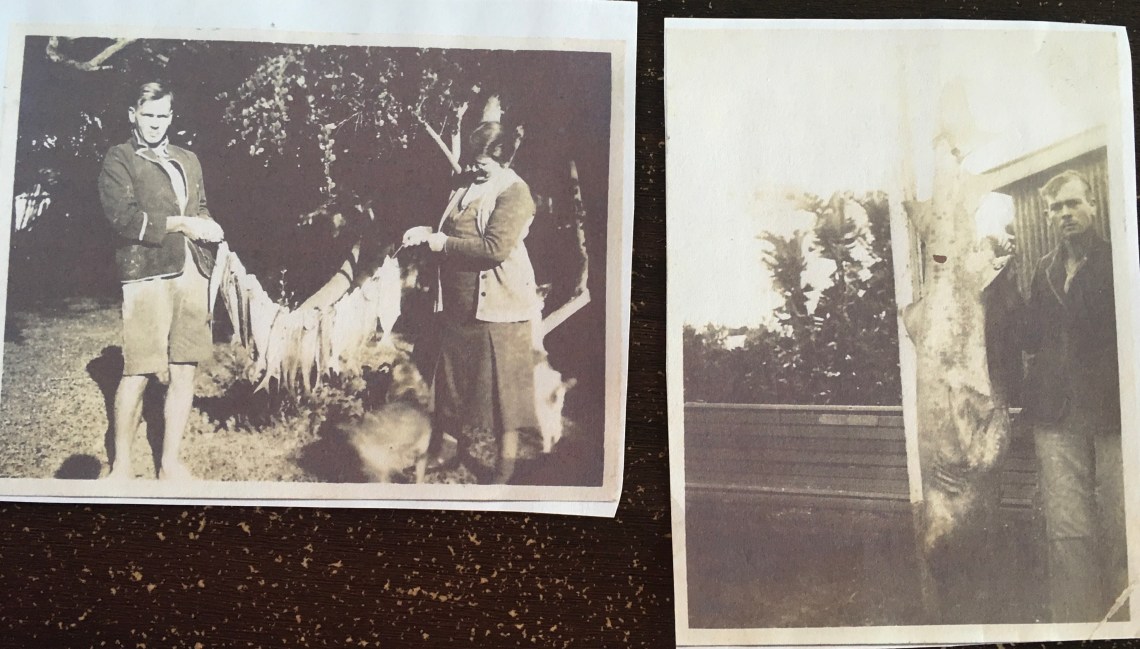
The Umtwalumi River was also a happy hunting ground, and used to be 20-30 feet deep in some places. Our chief method of fishing this river was to wait until the cup swallow chicks were just getting their feathers. At this time swifts would usually kick the chicks out of their nests dropping them into a pool below the krantzes. Sometimes a piece of earth from the nest would drop with the chicks. We would imitate this be throwing a sod of earth into the river. We would then cast our lines out with a leg bone of a fowl as bait and in no time a very big rock salmon would be hooked but very seldom landed.
Prawns, shrimps and cracker shrimps amongst others were also used as bait. We preserved these and other bait by mixing sugar and salt in equal quantities with a little pepper to keep off the flies. We removed the stomachs then soaked them in this brine for twelve hours. In the case of fish bait we would string it up in the shade to dry. In one instance our cat, Madam Shura, a beautiful big white cat helped herself by pulling the pieces along the string and eating them. When this was discovered steps were taken to prevent a repeat performance!
Spinning for shad one morning before the days of the drag spoon (we used a swivel, wire and barrel sinker, swivel, length of wire and the spoon) I was standing ankle deep in water when a fish flashed past me. I was in a more or less land locked pool when I saw a shark trying to get at the fish. I jumped out of the pool and fortunately the wave which followed was not large enough to enable the shark to enter the pool. By the third wave I got the fish – a salmon – onto the rocks. I was taking the salmon ashore when I noticed another salmon in a slightly larger pool. I jigged this one and it weighed 14 lbs – the first one was 20lbs. When both fish were on the sand a friend who had been watching said it was the first time he’d seen two fish caught this way.
One night when fishing I noticed that one of our dogs, Bonzo, was trying to catch fish. He would stare endlessly into a pool, then suddenly he would put his head under the water with no result. Tiring of this procedure, he jumped into the air, folded his feet under him and splashed the fish out of the pool – clever Bonzo! He would also hunt octopus which occasionally he would paw out of a crevice.
Our other dog Danny, a Drakensberg Spaniel, thus named by my father because he was born in Underberg, was also excellent with octopus. He would sniff among the mussels and rocks and barked when he found one. Thus Dad was never short of bait.
Lugs was also a spaniel and exceptionally intelligent. One afternoon we were all on the beach and my mother was wearing a jersey with pockets. I asked my mother to give me a cigarette and she gave Lugs the packet which he brought to me. I took out the cigarette and he returned the packet to mother. He was also a great pipe smoker much to the astonishment of the local African railway gang. He would go round with a bent pipe in his mouth for hours. He had to be put down when he developed pneumonia – what a sad loss.
What halcyon days they were! I was at school in Durban and all my holidays were spent fishing at Ifafa Beach and at Underberg for trout. While at DHS I used to go down to the bay at the weekend to catch mullet which I sold as live bait to the fishermen around me until one unfortunate afternoon. The SAR&H police came and asked me for my licence which, of course, I did not possess! I was told not to come again until I could produce a licence. Alas! This put an end to some extra pocket money.
We used to run down to the beach from school, have a bathe and return for roll call and prep. This used to be encouraged by one of our masters, Mr Bill Payne.
He was our Latin master, rugby coach, friend and general advisor. He was renowned for his stamina when he ran in the Comrades marathon from Durban to Pietermaritzburg in his rugby boots, size 14. He stopped at Drummond Hotel and ordered steak and eggs for breakfast and finished the race before the deadline. His funeral was one of the biggest ever to be witnessed in Durban. During his period as a P.O.W during the last was he was a pillar of strength to his comrades.
Another revered master was the principal, Mr A S Langley (the bull or “Mdevu” as he was affectionately known). During one school holiday my father and I were fishing Callaway water in the Underberg district. Unbeknown to me Mdevu was fishing the opposite bank with Mr Neveile Nuttall, also a teacher at DHS. I greeted Mr Langley and asked it he had caught anything. “Only a couple of small ones” he replied. When he asked what luck I had had, I replied “Oh a 3 pounder, a 2 pounder and a 1 3/4!” You should have heard his reply after his initial shock! Then he asked me what fly I’d used and I told him “Alexandra Jungle Cock”. “I don’t believe it” he said. As I had been fishing while talking I suddenly hooked another 2 pounder and landed it – you should have heard him bellow. “Why don’t you work like this in the classroom?” He was the grand old man of DHS and a fine sportsman.
It was a hobby of ours when returning home at the end of term to invest in “throw downs”. They were course sand mixed with some explosives covered in paper and we would throw them at any passing Africans. They would cause great panic and excitement.
In July 1935 when I was at Cedara Agricultural College, I took a trip to Lake Nyasa with Zeederberg SA safari. This Zeederberg’s father was renowned as the man who used zebra instead of horse transport, the reason being that zebra are immune to horse sickness while “salted” horses were hard to come by. On arrival in Johannesberg I discovered that the party consisted of 23 school teachers, major Pretorious the famous big game hunter, Uncle Tom who was well over 65, then Pommy Mac who was driving the Ford Sudan and Van the supply lorry driver. Jock who was supposed to drive the passenger vehicle was useless, so I took over the driving from Pretoria. This vehicle was an open sided affair with drop sides and the seat were composed of a ¾” piping framework with canvas seating. We travelled via Wylie’s Poort and Beit Bridge to Bulawayo, then to Livingstone, Fort Jameson and finally to Lake Nyasa. This sheet of water is very impressive. The natives used hollowed out tree trunks as canoes.
From the lake on to Dookza with that beautiful English Church built of stone, then to Portugese East Africa, across the Zambezi River by punt and we saw the stern paddle river boat which came up the river from Tete – one of the oldest settlements in East Africa. We then passed through customs at Motoka crossed the three span berg at Moodie’s drift. The famous Birchenhoff Bridge was not yet completed. We were pulled across the more or less dry river by three spans of 12 oxen.
So we arrived at Salisbury and eventually Zimbabwe ruins, returning to SA via Beit Bridge and the Kruger National Park and so back home. The petrol cost 5/6d per gallon compared to 1/6d in Natal. A pleasant rip was enjoyed by all despite the hardships and primitive travelling conditions compared to our present day jet age.
After achieving my diploma in Agriculture at Cedara I purchased a farm, Beeverstowe in 1938 in the Underberg/Himeville district. It had 5 miles of river frontage on the Polela River – all trout fishing. The house was unique – built of Yellowwood sawn in the Umkomaas valley by Mr Phipson. It had 1 inch thick planks, 18 feet long, 12-14 inches wide – these trees must have been a terrific size. The walls, floors and roofing timbers were all yellow wood. After many years I replaced the wooden veranda with a concrete patio. A yellow wood plank was left out in the weather overnight, by mistake, and were to be found twisted like barley sugar. Our operations consisted mainly of dairying, as I had a fine Friesland Herd, also some agriculture. I was one of the first to plant pastures and the most successful grasses were among the clovers. Mr Ivor Vaughan was the first to build a dam in the district on his farm Eaglescliff. I followed and built a 1.5 acre dam with only oxen and a dam scraper.
Looking at Underberg today the conservation of moisture is fantastic. Originally the conservancies controlled the fishing and there were two – Underberg Rivers Conservancy and Himeville Rivers Conservancy. These were later amalgamated to form the Underberg Himeville Trout Fishing Club in 1954. The following is an article I wrote for their journal on the occasion the 25th anniversary of the Club.
U H T F C – article from J M Kirkman 10/03/80
The Underberg / Himeville Trout Fishing Club was formed in 1954 because more and more water was being bought and hired by anglers from the Rand and Durban. The less fortunate angler, who could not afford to hire his own stretch, was being deprived of trout fishing.
The original committee elected in a meeting help in the Underberg Hall was composed of Messrs. R Hardingham, Vaughan, Raulston, Hughes, Kirkman and McDougal, all riparian owners with Messrs. Simpson, James and Gourlay representing the non-riparian owners.
On the formation of the club, Mr George Holmes, the then proprietor of the Underberg Hotel, very kindly gave us the use of a rondavel in the grounds. This accommodation is still used as the official fishing office.
I was allocated the position of Hon. Club fisheries officer as well as general factotum. This job entailed erecting boundary signs, beat signs, “no fires”, litter signs etc. I think most of these exist to this day.
The first dam in the district was built by Ivor Vaughan using oxen. This was followed by Kirkman, deJager, and Nigel Stone who all built their own dams. I might mention that I was the first angler to catch a 6lb trout in Ivor Vaughan’s dam, after my return from “up north”.
In the subsequent years, many dams in the district were built by the Midlands Earth moving company.
One cannot write any article about the club without mentioning some old names. Mrs Helen Hilliard “The cormorant” as she was know, Bard Wilkes, Singapore Aylward, Michael McDougal, Norman Roulston, Gappie and of course our faithful William Hughes and Dilys who have served the club for so long.
During the early days of the club we were approached by the Boot and Saddle Shellhole for funds. We organised two fishing competitions during the Easter vacations. The proceeds of these efforts can be seen in the form of the learners’ swimming pool at the Underberg School.
The “we believe you” cup donated by ? created great interest. I was fortunate to win it twice with a 5lb trout caught on the Polela (Reichenau Mission Water) and a 3lb trout on my own water on the Polela. I was fishing that day with Henry Clark and Colin Gold (bear witness Colin!)
The allocation of a boat to deserving dams has been of great assistance to fishermen.
William will recollect this incident. He and I were sitting in the office one morning when in walked an American tourist. He asked for a couple of yards of fishing. When told he could have ¾ mile he was astounded and replied “back home we get three yards”
I would like to conclude this treatise with a short “we believe you” story. It was a piece of good advice given to my late father by the then very young Mr William Hughes. The advice was”don’t use 2 flies on the lower Umzinkulu” This advice went unheeded by the elderly very experienced Wyndham Kirkman. Result was at midday he hooked “Rupert” named after Mr Vaughan who has hooked him previously. During the 20 minute battle, the old man had just seen the red loop cast appear above the water, when a 2 pounder came out of the bank and took his second fly. A difference of opinion ensued, and resulted in “Rupert” going down to the middle of the pool, jumping, with half the cast out of his mouth. The two-pounder was still “on”. This was duly netted. I witnessed this sad happening and the outcome was that we packed up, left Dunraven and returned to the South coast immediately.
J M Kirkman (sgd.)
We cannot mention trout in Underberg without remembering the old dedicated fishermen farmers who stocked their dams at their own expense and allowed the public to fish.
Fishing at Callaway after an afternoon storm, I netted a 3 3/4 pounder and took it to the original hotel in Underberg which was near the level crossing between Underberg Station and Woodford Holt. It was the custom there to display ones fish in the office and it so happened that on our return there were three fish on an enormous dish. They were roughly 1 ½ lbs each and the proud angler was describing how he had caught them. I went into the kitchen and showed Brian Wilson, who ran the hotel, my catch and he merely said “here’s trouble” and put my fish on a tray which he took to the office. The owner of the three small trout, looked at mine, glared and disappeared into the kitchen with his catch and was heard to remark, “beginners have all the luck”. My father who had been fishing with me asked how many years he had been fishing, five to six was the answer. “Well” said my Dad “that beginner has been fishing twelve to fifteen years – what can you expect”. We all became great friends after that and often met at the hotel.
Having just arrived from the coast on another occasion, my father was anxious to get onto the water. We went to “the banks”, then owned by Mr Johnson at about 4 pm. He agreed to our fishing and helped out his hand for the day’s fee which was 3/6 d. How cheap fishing was in those far off days!
I gave Roly Phipson, a neighbour of mine on the Polela, on of my own tied flies. He rode up to my farmhouse one afternoon, very exited, and begged me to tie him several more flies of the same pattern as he had been smashed up by a very big fish on his stretch of water. I started using this fly and have caught more big trout in the Polela than any other angler, according to Bob Crass of the Natal Parks Board, who wrote these details in the Farmers Weekly. This fly has been called “Kirkman’s Killer” by my friends.
Fishing “Kenridge” on the Polela with Hector McKenzie, we walked to the bank opposite the then St Josephs seminary and casting among the willows we took six fish over 3 lbs two of 2 ½ and 1 of 1 ¼ lbs. In one pool I noticed a locust being attacked by a ¾ lb trout. Each time the trout attempted to grad the locust it would be kicked in the mouth. Eventually the trout gave up the unequal struggle.
The Ngwagwane river near Coleford is renown for the “big ones that get away”. Once while fishing there I had run out of fishing flies viz. silver bodied flies. I went to Coleford store to buy some and on the way back I stopped to fish the big deep pool near the old SAP station, next to the road. I was fishing very deep and hooked what I thought was a stone until it started to move, and move it did! I judged the weight at 7 lbs at least and by now two local cars had stopped to see what was going on. The excitement was great and a loud “oh!” escaped them when they saw the fish. As I had no net I was calling for one in the meantime had let the line go slack. Of course the trout took advantage and off it went. I understand it was caught later and weighed 6 ¾ lbs.
Having got permission to fish a section of the lower Umzimkulu, I asked the owner if he had had any luck of late. He replied that he had not been fishing. I went down and had been fishing for a couple of hours when I came upon an Umfaan and some cheese bait. When questioned, he told me that he had been instructed to catch fish by the farmer! The Umfaan showed me three fish, the smallest was 31/2 lbs. At sunset I went back to pay my respects to the said farmer and to thank him. He immediately produced three fish which the umfaan had shown me earlier and said he had just been down and caught these three magnificent fish!
Are all fishermen liars or do only liars fish? (Isaac Walton)
The fishing stories of the early days in the Underberg district were too numerous to mention but I must mention the two Johannesburg fishermen who came regularly to the Himeville Hotel, and they used to return in the evenings with at least 2 2 pounders every day. They made a great show of oiling and greasing their lines and booked the same water each day, calling a gillie from a hut near the river. The riparian owner approached the gillie after this had gone on for several days and asked what bait they were using. “Entete” he replied, which is a grasshopper.
The owner of the water went immediately to the Himeville Hotel, a distance of at least 10 miles, and found the two so-called anglers in the “pub” discussing trout fishing and admiring their catch. Without any hesitation he told them both, in front of the present company, never to fish his waters again and needless to say they have never been seen in the district again.
Truth will out!
On another occasion a fisherman was asked for a light and inadvertently handed over the wrong matches, and to his chargin out jumped a grasshopper.
While serving in the Natal Carbineers in World War 2 we left the Premier Mine, Pretoria, by train and sailed from Durban to Mombassa, being escorted by an armed merchantman while at sea. Crossing the Athi Plains with Mt Kiliminjaro, snowcapped as a back drop, the chaps started to shoot at game next to the railway track. It was all very amusing until someone wounded a buck and then the trouble started. The train was stopped by the adjutant, a rifle inspection instigated and anyone having used a rifle was “put on the peg”. We proceeded to Gilgil and here game was really plentiful, especially guineafowl, which we would knock over the knobkerries. One afternoon two of us went down to the Kippery River with line and worms and caught trout, all between 2 and 3 lbs. We spent the night out and had a pack of wild dogs hunting unpleasantly close to us. It was frightening while it lasted.
The road built by the Italians in Abyssinia was very good and a lot can be said for their workmanship. At Amba Alagi when the Duke de Oasta surrendered, I found a fruit dish of beautiful beaten German silver which I kept. This has been a momento in our family ever since.
Our time in the army was not without its lighter moments. One evening during “stand to”, the dead silence was broken with “Halt, who goes there?” No answer, so it was repeated. Then for a third and last time. Still no answer. Then all hell was let loose – the whole perimeter opened up – brens, lewis, rifle fire. After about three minutes peace was restored and a patrol was sent out and found the footprints of a giraffe. This became known as the battle of Wagir.
When all the local farmer returned to the land after serving our country in World War two, life settled down to serious farming operations and some fun. This consisted of tennis and bowls weekly, fishing when the mood took us, polo, dances, and gymkhanas were the order of the day.
A highlight for me was in the early 1950’s when David Alexander, well known to some, decided to pioneer an overland route between Himeville and Mokhotlong in Basutoland over the Sani Pass. Up until this time the only communication with this outpost of the Empire was by pack horse or by aircraft. This was an air service from Ladysmith to Mokhotlong run by the “white bird man”, Peter Strong. I was asked by David to test the Sehonghong River from trout, his idea being to get a tourist attraction established across the Drakensberg.
Using short-wheeled based Landrovers and Jeeps and having to negotiate 42 reverse bends we reached the summit of the Drakensberg in approximately four hours. On looking back the view is magnificent and looking back most of Southern Natal can be seen and I believe on a clear day with binoculars, one can see the sea. On one of our many trips up this track we had my mother with us. She was then 79 years old and on reaching the top we met a well known Durban doctor who asked her what she was doing at that altitude. She was subsequently congratulated on her age and her pioneering spirit.
Carrying on, one reaches the Sani River on a vast plateau. This river is completely frozen in winter and used as a skating rink from time to time. The Black Mountain track with six reverse bends followed and it was from this track that the original Lammergeyers nest was discovered by a party consisting of Bill Barnes, Don Morrison and Godfrey Simmons – this made history. Further on in the steep Sehonghong valley which had to be negotiated with great care in low ratio, as indeed did the whole journey. While at Mokhotlong I fished the Orange River not far from the village, and at this point it is 40 yards wide, very clear, with semi-precious stones in abundance, mainly banded agage. I caught a 41/2 lb yellow fish – not a Natalis Barbus, the proper yellow fish. I had become a member of the Basutoland Trout Fishing Club. I gave it to one of the Bantu who the next day gave me some fish cakes which were delicious. He had skinned the fish, minced the bones and flesh. This could be an idea for cooking carp and other bony fish.
David alexander’s next problem was crossing the Orange River in the rainy season when it was in flood. He approached me about a punt and I devised a scheme which I had been working on in Nyasaland, requiring the following materials; 14×44 gallon drums, steel cable 1 inch thick, plain wire, four blocks and tackle, 6 trek chains and various small items. All this had to be transported by Jeep up the Sani Pass from Himeville on the rough hazardous track described above.
I took a tent and a labourer and camped beside the Orange River which was 100 yards wide at this point. I began by sinking the steel cable in a concrete slab at the far end. Approximately 10 yards nearer the river I erected a rail where the cable passed over the top and onto the nearer side. The same procedure was adopted on the opposite side. Now the punt – I bound seven drums together for each side and on top of the drums I places adzed timber, tightly wired and keyed; dug away the approaches, and there was the punt. My first attempt to cross with 10 bag of mealies, a ton, and using the current as propulsion was a great success. This punt was used for some time until washed away by exceptional floods and I can mention at this stage that Miss Pat Vinnecomb (of Bushmen Painting fame) and a friend stayed in my tent and were welcome companions in this lonely spot. I subsequently paid other visits to this lonely and desolate part of the world before the Basutoland Government decided to widen and realign the track. I tendered for the transport of dynamite and detonators from the railhead at Underberg to the magazine at the bottom of Sani Pass. The train used to arrive at about 5 pm and I would load the explosives on to a tarpaulin in my motor car, having removed the back seat.
One Saturday I called at the Himeville Hotel and was approached by Nick for a lift back to the Sani Pass Hotel. I agreed to take him and his wife and it was only when we were nearly at their destination that I informed Nick he was sitting on 10 cases of dynamite! A few days later I met a mutual friend who told me that Nick was still trembling and had remarked that he’d never been close to heaven that he was last Saturday! Needless to say he never asked me for another lift. He is still alive at the age of 83 and we often laugh over the incident.
Another highlight of the 1950’s in the Underberg/Himeville district was the building of the quite beautiful stone church, St Michaels and All Angles, in the Himeville village. We had worshipped in the primitive wooden building for some years and the local Anglican community decided that this could not continue. The local farmers carted dressed stone to the site between the vicarage and the wood and iron hall. We were fortunate at the time to have a very gifted African, who was a dedicated stone mason, Nelson Mhlope, in the district. So it was my privilege and pleasure to help in this project, motivated first by the Rev Eric Pennington, of the well know Natal family, and then subsequently by Rev Howrd Goodyer and Mostyn. The present landmark, this unique village church is a memorial to the dedicated farmers who gave of their time and talents.
Other amusing incidents come to mind – one being the day I was fishing from a boat on “Rad’s” dam with Henry and Hector. I repeatedly told Henry not to stand up while I was casting but he persisted in this. To teach him a lesson I moved the boat suddenly and over he went with his deerstalker floating away in the breeze. As he hit the water he yelled “Save me, I can’t swim”, I grabbed him by the seat of his pants and at the same time I was trying to hook his deerstalker hat which was slowly sinking. Hector meantime was roaring with laughter and not assisting me one little bit. All ended well.
While acting as fisheries officer for the club I accosted a fisherman for his licence. He was known affectionately to us as “Bard”. His reply was “I’ll show you my licence when you put the snappers in”
I have often wondered why some fishermen never learn that fishing illegally does not pay and certainly no satisfaction is obtained this way. I was told of a certain man and his wife were fishing with worms on Scotston water so went down there and there these two were with 12 undersized fish. They were subsequently charged and left the district.
During her long stay in the district Mrs Hilyard had such extraordinary experiences. She tells how one day, while fishing, the Umzinkulu she hooked what she thought was a rock. When she eventually released the fly she found that she had hooked the loop of a spinner.
On occasions when the Umzimkulu is discoloured, the side streams are clear. This happened when a friend of mine went to the pool where “Algy”, a large trout, lived. This pool is situated where the new bridge for the tarred road was built adjacent to Underberg. The stream from Ivor’s dam was fishable and there was about 8 feet of clear water flowing into the Umzinkulu which was dirty. Casting into this he took four fish, one of which was 4lbs. On returning to the hotel he was pestered as to where he had caught them, and you can imagine what happened the following day!
One day it was snowing and work was at a standstill on the farm, I took Les to Ivor’s dam and between us we took six fish, two of which were over 5lbs. At the same venue I took at trout of 6lbs 20oz. Ivor was shitting in the shack at the dam and I hooked what I knew was a very big trout. I jumped into his boat, followed by Ivor who rowed out and eventually netted the fish. When I attempted to remove the hook, Ivor said “for goodness sake, sit on the thing. I don’t want it to get back”. We went up to the house and weighed it. I had it mounted and many years later gave it to JF King to display.
I once saw an otter surface, and lying on its back started crunching something it had in its paws. From the sound I gathered it was a crab, I moved slightly and in an instant it has disappeared without a ripple. This was a very interesting observation.
It was my pleasure in 1948 to host the SA Scout Jamboraly. My farm Beeverstowe was ideally situated for such a camp having windbreaks and sheltered paddocks. It was also near the railway halt Woodford. Eight hundred scouts with their respective scout masters were housed in tents in the 18 acre field. The organisers had gone to lot of trouble in arranging for a special post office date stamp to be made, stationary printed, and a daily newspaper “The Jitters”. At the conclusion of this memorable event I was presented with an ebony elephant – the elephant never forgets – as a token of their appreciation.
During my farming experience, some thirty years in all, we had numerous pets. These were ostensibly for my three daughters born to us during our period in the Underberg district. The children were of necessity away at boarding school for long periods and the dogs were my constant companions during farming operations. The most outstanding was Brindy, a bull terrier cross fox terrier. His per aversion for cats and fowls and I have found him on the trunk of a tree, seven feet above the ground, having chased a cat along this slightly sloping tree. How he got there I wouldn’t know. When we wanted a fowl for the table we select a suitable rooster, pointed and shout “Koowea”. A great chase would follow with much hilarity and the poor victim would be caught immediately. Another amusing story would be “Wie kom saam?” and with much tapping of my “wiesa” I would set off towards the sheds. The dogs, wildly excited, would run on ahead and I would immediately turn around and go in the opposite direction, then conceal myself. Much fun would be had by all.
My farming operations were often puncture by trips to the Wild Coast in Pondoland for short periods. The late Mike Aldous of the Himeville Hotel was a dedicated sea fisherman and loved the isolated spots on this scenic coast. We would travel via Port St Johns for bait and from there take the route to our arranged destination. The bait, crayfish, octopus, mullet were plentiful and cheap in those days.
Our trip to Brazen Head was undertaken in a kombi, and on the way we picked up two gillies, and African and a coloured. On arrival at the top of the krantzes above the caves we were met by about 15 native women who were to carry our supplies and equipment to the caves. This was necessary as one could carry only one article at a time while clutching the monkey ropes and clambering down. The caves were in rocks 15 feet above the high tide mark and at spring tide the spray would make the bedding damp and sleep impossible. The ledge consisted of three fishing spots from which one could catch mussel cracker, sharks and bream. Along this ledge, 20 yards from our cave, Mike and his young African gillie were fishing and Mike suddenly yelled “get the gaff, quickly”. We rushed to find Mike pulling the gillie out of the sea. Mike had hooked a large mussel cracker and his gillie, having gone to gaff it, was struck by a wave, larger than usual, and washed out to sea. It was a lucky let off as we’d caught several large shark the day before. During the afternoon a shoal of porpoises came past within 30 yards and I threw a stone at one of them. With one accord they all streaked out to sea. It is extraordinary that these mammals and so sensitive to sound.
We caught 6 crackers plus various types of sharks during our three day stay, and it was certainly an experience not to be forgotten. Later I also had the pleasure of ‘blow holes” along the coast.
Many years later I was able to take my wife to the lovely Port St Johns and we returned to visit these glorious spots many times.
During the 1960’s there was an influx of Kenyan farmers to the Republic. They were keen to buy farms that were not too isolated and preferred to be near a village with sports, especially polo, so our farm was sold and we went to live with my mother, then a widow, at Ifafa Beach. Within a few months I joined the Natal Parks Board which was an occupation after my own heart, as my particular job was connected with fish and fish breeding. While on probation at Queen Elizabeth Park, the NPB headquarters, I built a rhino enclosure as it was the intention to keep rhino in Pietermaritzburg for the entertainment of the public. Also about this time the world ornithologists had a seminar in Natal. I had the pleasure of driving the party and at the conclusion of the seminar I was presented with Roberts Birds of South Africa – signed by the author. From here I was transferred to Nagel Dam where the warm water fish are bred in ponds. The climate in this part on the Umgeni River in the valley of a thousand hills is extremely hot and the trumpeter hornbill is a common site. I was then appointed hatchery supervisor at the Royal Natal National Park. This entailed the study and breeding of trout, patrolling water and general supervision of the fishing in the area.
Trout was first imported in 1882 by a Mr J C Parker and the result of this is evident today as every suitable water above 4000 feet has been stocked.
Breeding of trout takes place in winter when sexing of fish takes place at the end of April and the beginning of May. This is quite easily done as the female trout has a round jaw and the mail a pointed jaw, usually with a hooked up tip. These are kept separate in holding ponds and each week they’re netted and tested for ripeness. This is done by running ones thumb down the stomach of the female, and this is called stripping, the ova being produced this way. The male trout is then taken and with the same performance the milt is ejected onto the ova. This is gently stirred with a feather for a minute or so in a receptacle before being transferred to trays in the hatchery proper. The trays are plastic, trough 1’ x 10’, with cold water flowing over them gently. The first indication of fertility is when the ova have developed a black spot, this being known as the “eye” stage. Every day the dead ova have to be removed and thus the embryo stage is reached. On hatching the egg sac is still attached to the fry. When this is absorbed the delicate feeding process starts. This is a very critical stage as food which is to course will choke and kill the small trout. Trout pellets and finely ground liver are the chief dietary ingredients.
It was however, essential that new blood be introduced to the province and this was done periodically during the winter months, the ova was imported from overseas.
As the RNNP is a mecca for tourists, I organised lectures and tours of the hatchery. This proved of great interest to the visitors, both local and overseas.
During one of these lectures, Cynthis Lette, the renown South African artist, noticed a book “ The flowers and shrubs of the Kruger National Park” among others on my book shelf. She took it down and turned to one of her drawings, which she signed, and added that the conducted tour of the hatchery had been exceptionally interesting. I was very proud of this as she had recently been written up in the local press. Among other interesting people, I met were Mr PW Botha, who was then Minister of Defence, who when addressed by me in Afrikaans replied “Keep to your own language then you won’t get tied up”.
The administrator of the Transvaal was another dignitary and also a former Archbishop of Canterbury, the Right Reverend Coggin. Schools, both black and white would book for these tours and this project became so popular that eventually pamphlets were produced.
During our holiday period, my wife and I did some interesting excursions to other parts of the Republic. The golden gate area, now known as Hoogland park (Golden Gate Highlands National Park) was then only being developed. The Willem Pretorious Game Reserve (near the small Free State town of Ventersberg) and Allemans Kraal Dam had just been established as a holiday resort. These proved places of tremendous interest in the Orange Free State and on another occasion we toured the Eastern Transvaal en route to the Kruger National Park. At a later date we had the pleasure of “doing” the garden route which included the cango Cavs and visit to an ostrich farm. These were highlights to one who had not been out of Natal for many years.
Among the highlights of our various holidays was the finding of the pansy shell which in only found on the beach at Plettenberg Bay and the Mozambican coast. It is a very delicate shell resembling a skate fish in shape, with two eye slots, which are connected by a minute filigree design similar to a star. On the reverse side in the design like a pansy flower. All this in muted shades of cream and beige. We found our specimen on the stretch of sand between the Beacon Island Hotel and the Robberg Peninsula at Plettenberg Bay. The Robberg is a bluff stretching three or four miles into the Indian Ocean on the south side of the bay, and one can drive for a short distance along this headland. There is a hut at the point of this bluff for the use of the local fishing club and the whole area is a game reserve. There is still evidence in the hut of the tidal wave experienced on this coast in the 1960’s. On the southern slope of the Robberg there is a strandlopers cave, which has been sealed off to prevent vandalism and preserve it for posterity.
The rocks at the hotel are an ideal venue or fishing because while waiting for a bite, drinks can be ordered and brought by a waiter! More congenial surroundings and atmosphere would be hard to find. In the afternoon fishing boats which had been out in the bay since dawn would return with their catches of mackerel, so bait was not a problem. A gillie was essential and the coloureds are very knowledgeable about the fishing conditions and can advise strangers to the best fishing spots.
Our halcyon days at Royal National Park were punctured by some amusing incidents, especially where the baboons were concerned. Once while walking along the top of Dooley, above the hutted camp, Bill saw a troop of baboons 250’ below him on a flat, where they were feeding. He thought it would be fun to find out what would happen if he threw a stone amongst them and was not disappointed. By a fluke, he hit one and what followed was quite unexpected. The baboon which was hit slammed his fist into his neighbour who intern retaliated to the next one and in no time at all there was a tremendous melee with each baboon fighting every brother in sight. Complete chaos ensued until they scattered.
During feeding time at the trout hatchery at the Park, I noticed a baboon at a peach tree in the vicinity. These creature are quite destructive and break branches while eating peaches and meilies. I loaded a 12 bore shotgun with number 8 shot and while he was retreating up the krantze, I fired and hit him in the rump. He immediately yelled out a “bogum, bogum” and started slapping his backside with one hand while climbing the mountain slope. It appeared that he thought he had been attacked by a swarm of bees.
For many years the excess water from the hotel supply at the park was channelled into an earth dam near the Mahai River at the bridge, but it was not stocked with trout as it was unsuitable for fishing at one time. It was drained and I rebuilt the wall, and using a tractor and dam scrapers I heightened and waterproofed it. Since then, it has been reported that some good fish have been caught. The approach to the hotel has been much enhanced by the beautiful view of the dam from the main road.
Alas, all good things come to an end, and after working with trout for five years it was time to retire. Now, where to go? The call of the sea beckoned me back to the Natal south coast, but not to the little backwater of Ifafa beach. At our age we opted for amenities such as shopping, banks, a hospital, bowls and fishing. Oh I must get my priorities right! Of course I mean fishing first, it didn’t matter about the rest. However our natural choice was Scottburgh being adjacent to Durbs and a good jumping spot for most centres.
We bought a property adjacent to the beach, but I was disappointed to find that the fishing from the rocks had deteriorated immensely over the intervening years. This I think was due mainly to a mass of nylon fishing line, which does not perish forming an impregnable barrier. I did however manage to land a few large fish from the beach, including a 106 lb. salmon and a 80 lb. kingfish, and several other large fish. During the winter months when there is a land breeze, kite fishing was a great source of excitement. Scottburgh is situated at the mouth of the Mpampinyoni River, which means the place of many birds and is derived from the old Umkomaas / Umzinto drift, where swallows nest in their thousands in the krantzes. When a batch of flying insects hatched out, these birds were a sight worth watching and how they did not collide with each other was amazing.
We were soon absorbed in the local community life and subsequently I was engaged by the local municipality to establish parks and gardens and to beautify the new complex built at the “point” in December 1974. I was also connected and assisted with the re-planning of the local golf course.
We have seen many changes in this area. I well remember when Major Miller arrived in his aircraft and landed on the Park Rynie gymkhana ground, where Halfway Service Station now stands.
Starting a garden from scratch after acquiring a new home is not all fun and games, having thought I was due for retirement I found I was very much mistaken! I often had a boulder on my shoulder but life was very pleasant for about nine years until our particular area got built up. In the end we could not get a good view of the sea and passing ships.
This robbed us of a very big interest so we eventually made another change and returned to our beloved hinter land among the rolling hills of the midlands and near that beautiful public resort, Midmar Dam, where the yachts on a fine day are a spectacle not easily forgotton with the green hills a lovely backdrop.
Natal certainly is the garden province and how privileged we have been to be part of it for well nigh seventy years.
Green are the hills of Natal
Deep are the rivers that run
Blue is the sky
Where the clouds ride on high
And the eagles fly.
Here let me dream near a cool mountain stream …..


ABOUT THE AUTHOR
John Kirkman is the second son on the late Wyndham Kirkman of Equeefa in the Umzinto area. He has lived all his life in Natal except for a short spell in Grahamstown for education, and in Abysinnia and Egypt during the second world war. He farmed for many years in the Underberg/Himeville district and is a well know and keen sea fisherman and dedicated trout fisherman. He is a life member of the Underberg / Himeville Trout fishing club and is an authority on trout breeding. In 1939 he married a school teacher from Pietermaritzburg and the couple have three daughters all married and living in Natal. He now lives in semi-retirement with his wife in Howick, within easy reach of his beloved trout streams and dams.

 Pink Farm Chick