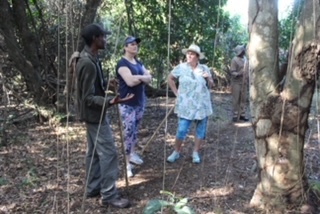
A deep breath, opening all the senses and the sound of the city drops away and is replaced by the sound of the forest with the sea as the background soundtrack. This is what you get when you take a dip into the Hawaan forest in Umhlanga and go “forest bathing.” Just open and immerse all your sense in the sights, sounds, textures, and smells of the natural setting and prepare to be awed. In very PFC (Pink Farm Chick) language – Forest bathing 101 is …. the trees all give good vibes into the air and by being present and taking this in, it is all good for your vibe as well. Take your time, hug trees that call your name, feel the course bark, smell the crushed leaves, and pick up the fallen seeds. The forest is sentient and so are you.
This was all a bonus as Bernard (an employee of WESSA) shared his knowledge about the various trees and vines in the forest linking them back to their many uses in his African Culture. The Hawaan forest has over 186 tree species, many which are endemic to the area. Our short walk took us into the secondary forest with the primary, old-growth forest being further down the hill and into the lagoon, which is presently still out of bounds for the WESSA tours, due to the chemical spill that happened in July 2021. The Hawaan forest was declared as protected the 1860’s, when it was owned by the Campbell family but before that was seen as special land open only to Royal hunting parties. The Hawaan is now a Climax dry coastal indigenous forest so called because it has reached its full potential in terms of growth as it is now producing its own shade and Dry because a river does not follow through it. All this built on an 18000-year-old sand dune.
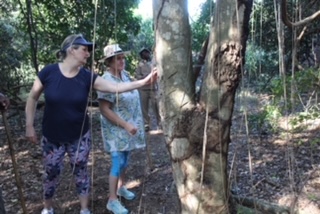
Bernard showed us the Buffalo thorn which has many spiritual uses in the African Culture. The most interesting one for me was that it was often planted over the remains of the Chief so that his spirit would live through the tree and give off his “good vibes” to all around him. Another interesting fact for me as a PFC and wife to the HF (Happy Farmer) is the use of the Thorney flat bean as a weaning tool, coiling a section around the nose of the calf so when it tries to suckle its mother it is extremely uncomfortable and the mother kicks out. The White stinkwood was used as a notice board to fellow hunters and evidence of this is still scraped into the tree bark…one scrape in this direction means beehive ahead …etc. The Natal hickory and the Thorney elm were all used in making fighting weapons, but the Hickory is softer wood so mainly used for fighting sticks and the harder Elm for the often – fatal knobkerrie. Vines drape down as long roots looking for water, vines curl around each other making a strong rope and the parasitic vine wrapping around bigger trees. Bernard had a story and use of them all.
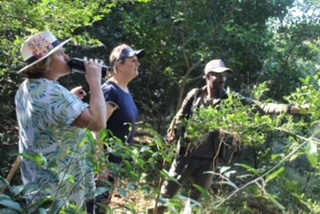
As with many forests walks the birds were very vocal but spotting them in the forest canopy was near impossible, although we had a brief glimpse of the forest weaver, a fork tailed drongo and the robin chat. We also got a glimpse of the very illusive Bushbuck baby.
The Hawaan forest is continually under threat by development. And it is the challenging work of a few people with foresight that this piece of living history is protected.
I thank you so much.

 Pink Farm Chick