
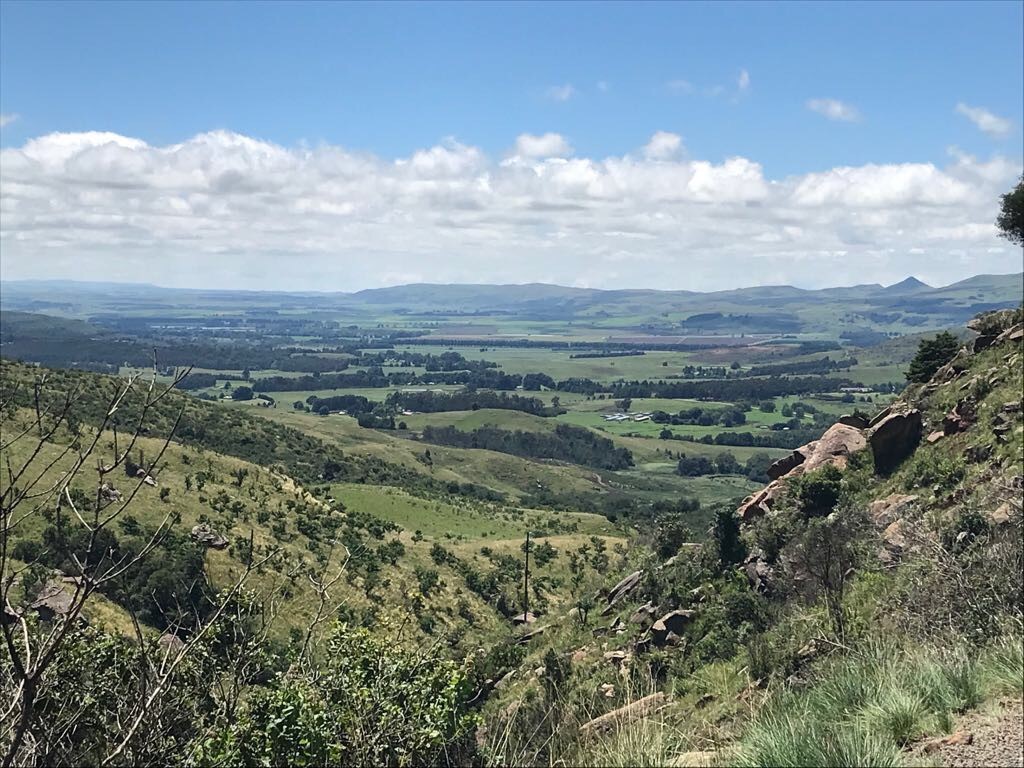
The Kamberg Valley …. “”How green is our valley”
photo taken from Highmoor showing the valley down below …
The Beginnings of Kamberg – shaping our Valley
1. Voortrekkers
2. Bushmen, British and Bantu
3. From the Coast
NOTES FROM THE WRITER
Nothing in life is constant … except change. This is the same for farming and certainly for our Kamberg Valley. Owners change, enterprises change, and people adapt with the times. Farmers, and their wives, must constantly stay in a dynamic state to take advantage of all and any opportunities that come their way. And to thrive, and not only survive, is a constant challenge for all of us.
I have tried to capture the Kamberg Valley as it is in 2016/2017/2018. Unfortunately, I can only document and research into what I know of the Valley, I do not claim to know everybody and everything, so some people and enterprises may be excluded, I am very sorry for that.
I have tried to stick to facts as far as possible, but many details are taken from fire-side stories and pub-talk. The Kamberg Club, with the Wheel and Plough at its center, is one of the many places in the valley that gave me inspiration and so a handful of salt is required for many a story.
The Happy Farmer and I have been active in the KVA so I have tended to be biased along those lines and to the people that we have met, and got to know from the Club.
THE KAMBERG TAPESTRY ….
The Beginnings of the Kamberg – shaping our Valley
1. Voortrekkers
As we know the great trek was an exodus of various parties and various groups from the colonial rule of the Cape Colony towards the hinterland of the country. Piet Retief and Gert Maritz were two of the prominent leaders who lead their groups into Natal. It was in October 1837 that Retief stood on the top of the Drakensberg, looking down on the rolling green hills of Natal. Along the way many families broke off, settled, and began their “new life”. Either due to differences or the beauty and potential they could see in their surrounds. One of the groups was led into the Kamberg Valley by the Mandy family who eventually settled in the Orange Free State in the now Verkykerskop region.
The Buys family was one of these who decided to call the Kamberg their home and settled in the Valley. The original voortrekker wagon was housed in the shed well into 2017. Refurbished and sold or given away…. The stories abound.
The Van Der Westhiuzens were also a settler family in the valley. Generations later Corrie would marry Stoffie Buys and the farming legends would continue.
2. Bushmen, British and Bantu
The land that the voortrekkers settled on was not empty though. The Khoi and the San people lived in the Drakensberg, hunting, and migrating as the seasons changed. But they would not be the only human inhabitants for long, the green rolling hill of Natal and the beauty of the Kamberg attracted various people.
During the seventeenth century the Bantu people started moving into the foot hills of the Berg and the Bushmen were forced to relocate more into the mountains. But this influx of bantu people was enhanced when in 1848 the amaHlubi and the amaPutini tribes fled across the Buffalo River into the Klip River country following conflict in the northern sections of the province. Langalibalele (the King of the Hlubi people) appealed to Martin West, the lieutenant governor of Natal for protection. In December 1849, after negotiations, the amaHlubi, now reduced to 7000 in number, were granted 364 km2 of good land in the Kamberg Valley. One of the hopes were that the amaHlubi would provide a buffer between the bushmen and the settlers and so protect the settlers’ cattle from the bushmen. In 1873 a law was passed that required all firearms to be registered in Estcourt, disagreements ensued, and the result was Langalibalele and his people fled from Natal over the Drakensberg into Basutoland (Lesotho). Langalibalele was then captured, tried, and sent to Robben Island. There was great outcry about his trail and it was described as a “disgrace to British Justice”. Finally, in 1887 he was permitted to return to Natal but confined to the house arrest. He died in 1889 and is buried at Ntabamhlope. A mountain at the head of the kamberg valley.
As an interesting side note – an ancestor of Ed Erskine (a current resident of the valley – who grew up in the Cape Province) was involved in the chase of Langalibalele up the Drakensburg and lost his life at the top of the pass during an ambush. Another ancestor of Ed’s is the land surveyor after whom Mount Erskine (situated in Highmoor world heritage site at the top of the Kamberg Valley) is named.
British influence came mainly in the form of troops that were stationed all along the Drakensberg to try and assist the local farmers with the “Bushmen problem”. Local inhabitants were raiding their stock and fields and causing problems for the farmers.
3. From the Coast
People also came from the coast to explore the hinterland of the new country.
ROSETTA … the rose of the midlands … a hamlet with a big heart.
The existence of a market place is often the difference between a town and a hamlet, but what happens if there is a country market twice a month on Saturday mornings? A chance for Rosetta to show case local produce, hand-made products, and crafts and for general chatter and mingling. All ideally placed around the village dam under the big trees in a beautiful country setting.
Rosetta has an interesting and varied history. From a gateway to the fresh trout filled waters of the Kamberg Valley, a pit stops while travelling the R103, to the old mill constructed on the village dam which was home to the “oldest and most trusted” flour in KwaZulu Natal – Blue Ribbon.
Rosetta booked its place in KwaZulu Natal with the building of the Rosetta Hotel in 1896 while the construction of the Meshlyn bridge in 1895 across the Mooi River secured a route up into the Kamberg Valley and beyond. The Honourable TK Murray CMG Minister of Land and Works opened the bridge. Murray became a prominent figure is the defense of Natal against the Boer army. He was mentioned by Colonel Redvers Buller in his dispatches back from the front lines for his efforts in much of the Natal conflict
The farm Wellington is the original farm on which Rosetta was established, and the main house is a Sir Herbert Baker design. Sir Herbert Baker was a British architect under the patronage of Lord Milner. He designed many of the original farm houses in the midlands area of which Wellington was one. He is also credited for designing the Union Buildings in Pretoria and St. Johns ‘College in Johannesburg. His designs included a deep mosaic tiled veranda, intricate wrought iron pillars and wooden paneling with carved elaborate wooden fire places and stained-glass windows. The wide passages he designed, are wide enough to draw a horse and carriage through. He used dry local stone for the walls and iron for roofing.
Although trout are not a native species to Natal, by the early 1900’s the government of the day well stocked the rivers of Natal. They were considered the best fishing waters in the country. Trout fishing had become a significant tourist attraction for the midlands. The Rosetta hotel, as with many local hotels in the area, served as a base for travelers exploring the waters of the Kamberg Valley and beyond. In the early 1900’s The Rosetta Hotel was known for its excellent hospitality, the guests were pampered, and the beautiful scenery. It was also affordable so met the needs of the entire families and households when they ventured into the midlands on horse-drawn transport needing accommodation and supplies. The Rosetta Hotel advertised its electric lighting and hot and cold water and pitted itself as the “ideal holiday health resort” The Natal Midlands had it all for the fisherman. The perfect altitude, moderate climate, excellent accommodation, convenient situation to rail and river with beautiful typical trout streams. Clear water flowed over rocky bottoms, the banks were clear of shrubs and bushes and the river was on average 30 feet wide. In 1901 when the Natal Anglers Association was formed Mooi river and its surrounds was considered to have the best trout streams in the country and offered the best sport fishing in the colony. This tourist attraction remains to this day and is still plays an important part in the growth of the area.
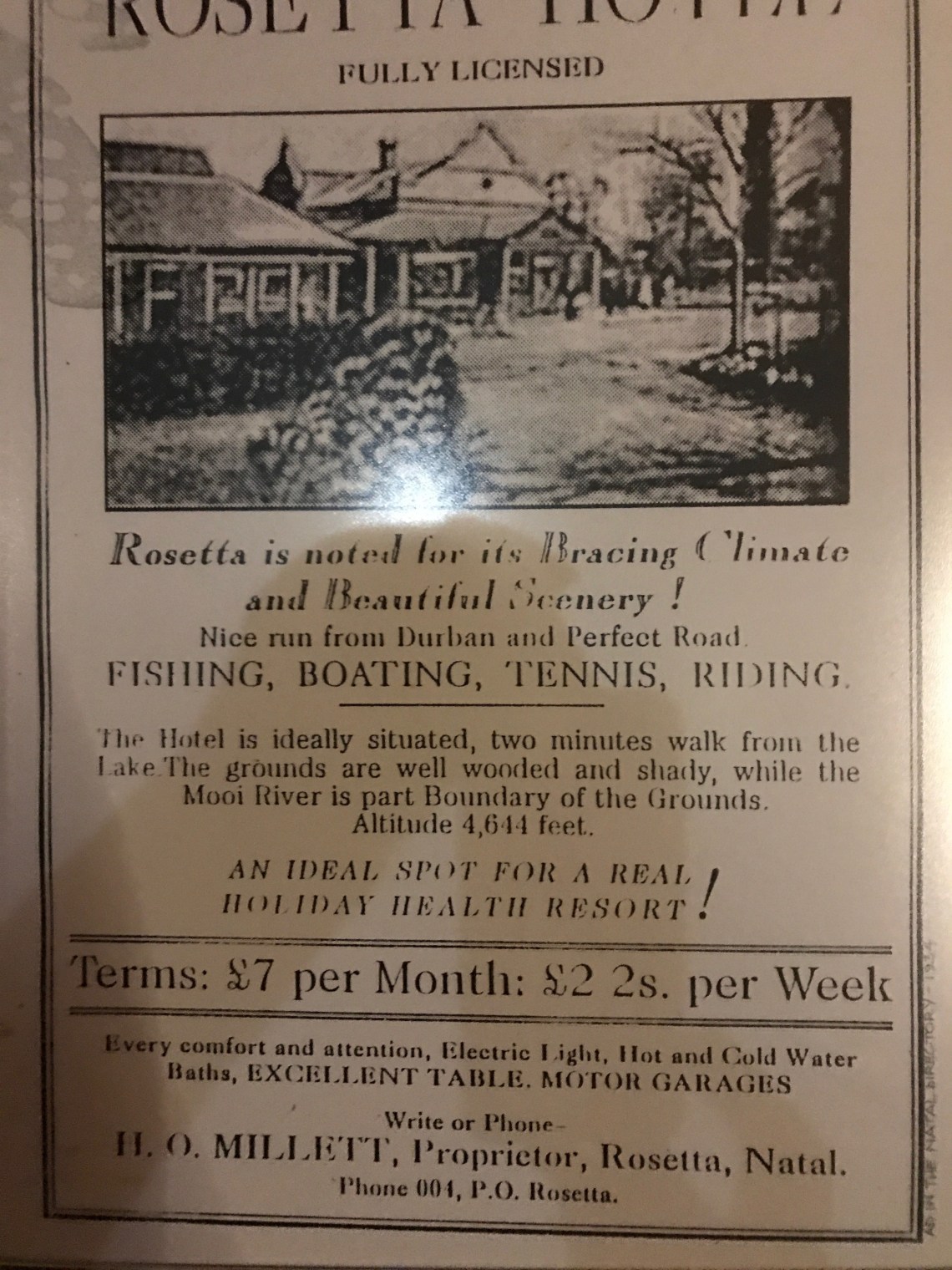
poster hanging in the Rosetta Hotel …
It was in 1875 that the first attempt to ship Trout to South Africa occurred, which died during the voyage. Then in 1882 John Parker wrote to the British publication ‘The Field’, asking for advice on how to introduce trout to the area. In response, Sir James Maitland sent him a gift of 10 000 Brown trout ova, unfortunately none survived. Undaunted, Maitland sent another 10 000 ova the following year, but these also perished. However, the idea of breeding Trout motivated Cecil Yonge in 1889 to obtain a government grant for funding to introduce Trout into South African waters. Yonge selected Boschfontein in Balgowan as the site for the first trout hatchery in South Africa
In 1890, many of the 30 000 imported ova from Loch Lagan in Scotland hatched successfully, and in May of that year, the first 1500 fry were released into the Bushman’s River, followed by the Umgeni and Mooi catchment. This process continued each year until most of the province’s suitable rivers were stocked. By 1893 Trout were being successfully bred in captivity.
In 1897, Rainbow Trout were introduced from North America, a species that grow faster than their Brown cousins and two years later they were being successfully bred and introduced into rivers in the Western and Eastern Cape, Mpumalanga and of course Natal.
Due to their ecological niche, only being able to breed in cold, clean, well-oxygenated rivers, viable Trout fishing areas were very rare. And by 1909 the Midlands of Natal was becoming known as a prolific Trout fishing destination and traveling by horse-drawn transport many a fly fisher first visited the Kamberg area
By 1926 Trout were well established and in these early years, a man kept what he caught, and the rivers of Natal became known as trophy Brown Trout waters with the Kamberg growing in popularity as prime Trout country. In 1947, the Natal Parks Board took over the administration of Trout fishing in this province, establishing hatcheries to supply fish. Notably the Kamberg Trout Hatchery was largely responsible for the initial stocking of all the dams that were being built for farming irrigation purposes with Trout.
By the 1960’s Trout were being commercially farmed and the pastime of catching a fish on fly was generally reserved for these naturalized species. The sport became quite popular in the seventies, resulting in the Natal Fly Fishers club being formed in 1972 to give recreational anglers access to productive Trout fishing waters.
In 1980 some provincial conservation organizations stopped supporting Trout, as they were not indigenous, and this gained momentum, until the closure of all Evemzelo’s – KZN Wildlife – hatchery’s and the listing of Trout on the exotic list.
Fortunately, commercial hatcheries, such as Giants Cup, Bushmens and Cathedral Peak continued to breed Trout for recreational purposes.
The Mooi and Little Mooi rivers continued to support a very healthy population of Brown Trout, that after generations of natural breeding, acclimatised to Southern Hemisphere conditions, becoming the apex predator in this catchment.
In 1986 The federation of South African Fly Fishers was formed – FOSAF – to unite fly fishers and engage authorities on water quality, conservation and promote the sport of fly fishing.
And over the next decades what was once a pursuit reserved for titled gentry became affordable and accessible to any passionate angler, resulting in the hosting of the Kamberg Trout Festival in1997, laying the foundation for the fly fishing festivities that this area is renowned for.
The Kamberg Trout festival was the brainchild of Mike Poplett, who along with the entire Kamberg community, opened their private Trout waters and homes to enthusiastic anglers for fundraising. The popularity of this wonderful event, has resulted in the distinction of it being the largest single fly fishing festival on the African continent. Hosted at the Farmer’s Association, it’s a festive gathering that is celebrates fly fishing, with all profits generated going back to the local community, assisting in many development programs. It has, over the last few decades highlighted the quality of fly fishing to be found in the surrounding dams and hospitality that the Kamberg Valley is renowned for.
At the turn of the century, the concept of catch and release only fly fishing was pioneered by WildFly, a club created to manage the local fisheries and conserve the quality of Trout waters in the Natal Midlands
In 2001 the Corporate Challenge was born as a mechanism to fund the necessary stocking required to manage these dams effectively. The atmosphere of the legendary Notties coupled with the calibre of fly fishing resulted in this growing from a single event, into one held over three qualifying legs and a grand final in the Winter season. Over the preceding years, WildFly’s fishing conservation initiatives have grown to include a television series that is now broadcast around the world highlighting the myriad of species that can be caught on fly.
The catchment waters of the Drakensberg remain an important sanctuary for Trout and at the heart of WildFly and the Kamberg’s commitment to protecting the Wild Fisheries of South Africa.
Contribution by GARETH GEORGE
Internationally renowned Aardmore pottery used Springvale Farm in Rosetta as it bases for a few years from 1996 but is now situated in the Caversham valley further down on the R103. Aardmore works of art are widely exhibited and grace many national and international galleries and collections.
One of the faces that have seen many changes in Rosetta is BB Safla from Sadecks Supermarket. Set up in a traditional trading store layout, the shelves are laden with brightly colored goods, the draws are bursting at the seams with all types of ribbons and hair accessories and her freezer and fridge and choc-a-bloc with homemade samosas, roti’s, and pastries. You can get anything here from aluminum bowls, glass ware, hair accessories, groceries, and your post from the postal agency. BB and Ahmed have been an integral thread in the weave of Rosetta for over 20 years. Hard work and an interest in their customers difficulties is what sets Sadecks (Ahmed’s second name) apart and makes it so important in the lives of many of the Rosetta locals. They interact and show genuine care about their customers and you are not only purchasing your items from them, but the general gossip and concern comes free of charge. Talking to BB about their lives and work is a very formal affair, she could make a taxi driver nervous! – she is not given into emotion and passion but the minute one of the regulars walk in it all changes. BB and Ahmed know their shoppers concerns and joys and share in both, throwing advice in the general chatter. This is while they are unearthing the special delivery they ordered.

 Pink Farm Chick
thoroughly enjoyed the Kamberg history.
LikeLike